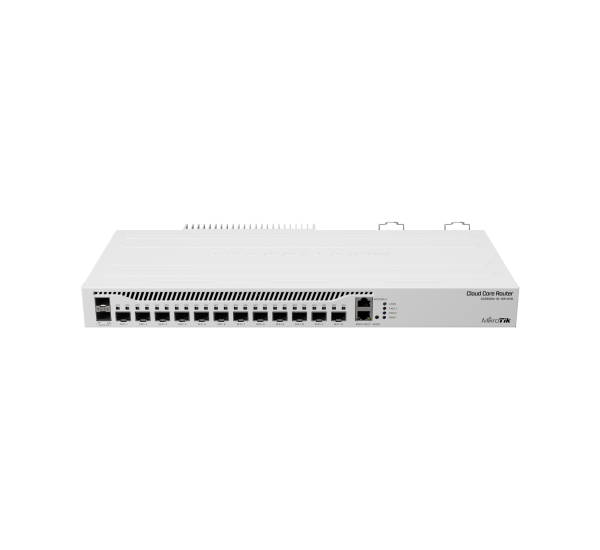
The CCR2004 is part of MikroTik's 2000 series and marks the move from the Tilera architecture to a more modern x86-64 platform. This model specifically is designed as a high-density SFP+ switch-router, making it ideal for data center and core network applications where you need many 10G connections.
Key Specifications at a Glance
Note: There's some confusion in the naming. The correct model is CCR2004-1G-12S+2XS, where the "2XS" actually represents one QSFP28 port that can be used as 100G, 40G, or broken out into 4x25G/10G.
Detailed Analysis of Features
1. The Big Change: x86-64 Architecture
This is the most significant aspect of the CCR2004 series:
Intel Atom C3338: A modern, low-power x86 processor
Benefits over Tilera:
Better support for newer RouterOS v7 features (like containers)
Improved single-threaded performance for certain tasks
More standardized architecture with better software compatibility
Considerations: May have different performance characteristics for pure routing compared to the massively parallel Tilera chips
2. Incredible Port Density & Flexibility
This is where the CCR2004 truly shines:
12 x SFP+ Ports: Twelve dedicated 10G ports - perfect for connecting servers, storage, and other network equipment
1 x QSFP28 Port: A single 100G port that can be used as:
1 x Gigabit Management Port: For out-of-band management
3. Hardware Offloading
Like other CRS/CCR devices, it uses Marvell switch chips for hardware offloading:
Layer 2 Switching: Wire-speed between all ports
Layer 3 Routing: Hardware-accelerated static routing
Bridge Filtering: Basic firewall rules in hardware
Performance Expectations
Simple Routing: Can handle 50+ Gbps with hardware offloading
Firewall with Rules: 20-40 Gbps (depending on complexity)
IPsec VPN: 5-10 Gbps (benefits from AES-NI acceleration in the x86 CPU)
BGP: Can handle large routing tables comfortably
Strengths and Advantages
Massive 10G Port Density: 12 SFP+ ports in 1U is exceptional value
100G Capability: Future-proof with high-speed uplink potential
Modern x86 Architecture: Better compatibility with new RouterOS features
Hardware Offloading: Maintains wire-speed performance for switching/routing
SSD Expansion: M.2 slot for additional storage for logging, containers, etc.
Excellent for Virtualization: Can run containers in RouterOS v7
Weaknesses and Considerations
Only 2 CPU Cores: While efficient, it has fewer cores than Tilera-based CCRs, which may impact certain heavily parallelized workloads
Complex Port Breakout: The QSFP28 port configuration can be confusing for newcomers
Power Supply: Single internal PSU (no redundancy)
Fan Noise: Can be loud for office environments
Learning Curve: Understanding when hardware offloading applies vs. when traffic hits the CPU
-750x250.png "Datacom Technologies (BD)")