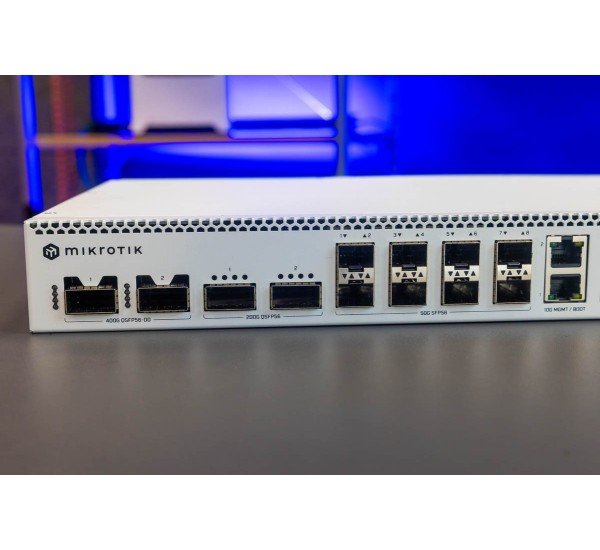
The CRS812 is a 1U rack-mounted switch that stands out for its eight SFP+ ports, making it a cost-effective 10G aggregation switch. The "DDQ" in the product code typically refers to the specific hardware revision or regional variant.
Key Specifications at a Glance
Detailed Analysis of Features
1. The Star Feature: Eight SFP+ Ports
This is the primary reason to consider the CRS812.
10G Density: Eight 10G ports in a 1U form factor at a very attractive price (especially used).
SFP+ Flexibility: Supports both 1G SFP and 10G SFP+ modules, allowing you to connect to a wide variety of equipment.
Perfect for Aggregation: Ideal for:
Server Farm: Connecting multiple servers with 10G NICs.
Backbone Switch: Linking multiple access switches (like CRS3xx series) via 10G uplinks.
Storage Network: Connecting to a NAS or SAN with 10G connectivity.
2. Port Configuration
3. Performance & Hardware Offloading
Wire-Speed Switching: Like other CRS switches, the Marvell chip provides hardware offloading for Layer 2 switching and basic Layer 3 (static routes). When configured correctly, it can handle full line rate on all ports simultaneously.
CPU Limitations: The Atheros CPU is quite weak by modern standards. It should only be used as a switch. Any CPU-intensive tasks (complex firewall rules, QoS, VPN) will severely impact performance.
Strengths and Advantages
Excellent 10G Port Density: One of the most affordable ways to get eight 10G ports.
Low Power Consumption: Typically draws only 15-25W, making it very efficient.
Hardware Offloading: Provides true wire-speed performance for switching.
Full RouterOS Control: All the configuration flexibility MikroTik is known for.
Great Value on Used Market: Often available for a very low price compared to its original cost.
Weaknesses and Considerations
Very Weak CPU: The 600 MHz MIPS CPU is inadequate for anything beyond basic switching and routing. It cannot handle modern RouterOS features efficiently.
Limited RAM/Storage: 128 MB RAM and 16 MB storage are minimal and can limit configuration complexity and logging.
Aging Hardware: This is an older platform and may not receive new features in future RouterOS versions.
No PoE: Lacks any Power over Ethernet capabilities.
Configuration Critical: Must enable Hardware Offloading in RouterOS, or performance will be terrible.
-750x250.png "Datacom Technologies (BD)")