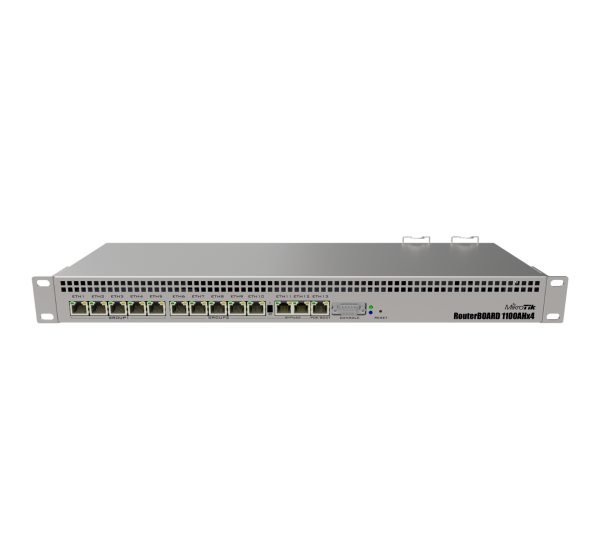
The RB1100x4 is a desktop/rack-mountable router from MikroTik's "RouterBOARD" series (as opposed to the "Cloud Core Router" series). It was designed as a high-performance solution for small ISPs, businesses, and demanding network environments before the CCR series became dominant.
Key Specifications at a Glance
Detailed Analysis of Features
1. Processor Architecture - ARMv7 (Annapurna Labs)
4-Core CPU: This was quite powerful for its time and can still handle significant loads.
ARM Architecture: More efficient than x86 for pure routing tasks, but less versatile than modern x86 or the Tilera cores in CCRs.
Performance Context: It sits between modern consumer routers and the current-generation CCRs in terms of raw processing power.
2. Port Configuration
3. Hardware Design
Desktop Form Factor: Can be placed on a shelf or mounted in a rack using a separate rackmount kit.
External Power Supply: Can be a point of failure but is easy to replace.
Passive Cooling: Fanless design, making it completely silent – a significant advantage for office environments.
Performance Expectations
Simple Routing: Can handle 2-4 Gbps
Firewall with Rules: ~1 Gbps (depending on rule complexity)
IPsec VPN: ~200-400 Mbps
BGP: Can handle moderate-sized routing tables (tens of thousands of routes)
Strengths and Advantages
High Port Count: 13 gigabit ports in a compact, silent device is still very useful.
Complete Silence: Fanless operation is perfect for offices, libraries, or any noise-sensitive environment.
Proven Reliability: A mature, stable platform that has been widely deployed.
Full RouterOS License: Level 6 provides access to all features.
Excellent Value on Used Market: Often available for a very low price, offering great capability for the money.
Low Power Consumption: Very efficient for its performance level.
Weaknesses and Limitations
Aging Architecture: The ARMv7 CPU is showing its age compared to modern x86 or Tilera processors.
No SFP+: The SFP port is limited to 1G, so no 10G capability.
Shared SFP/Ethernet Port: You must choose between using port 13 or the SFP cage.
External PSU: A potential single point of failure.
Limited RAM: 2 GB is sufficient for most routing tasks but can be tight for very large connection tables or BGP feeds.
Ideal Use Cases
Small Business Core Router: Perfect for an office with 20-100 users, handling routing, firewall, and basic QoS.
Silent Office Environment: Where fan noise from other equipment would be disruptive.
ISP Customer Premises Equipment (CPE): For business customers requiring multiple Ethernet ports and advanced features.
Home Lab / Prosumer Core Router: For enthusiasts who need more ports and power than a typical home router.
VPN Gateway for Small Office: Terminating a handful of site-to-site VPN tunnels.
-750x250.png "Datacom Technologies (BD)")