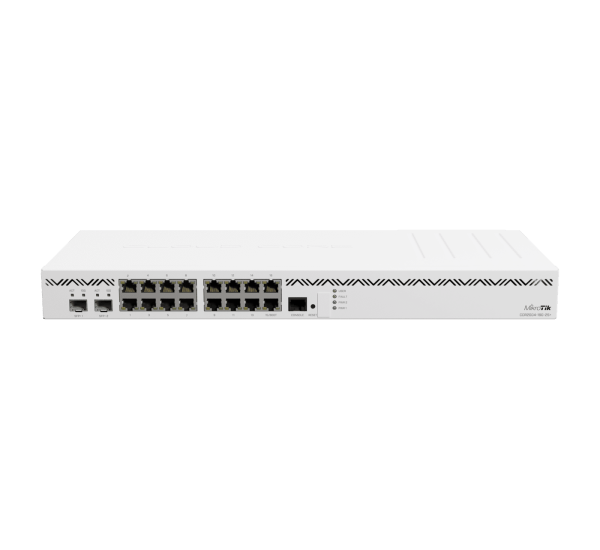
The CCR2004-16G-2S+ is a 1U rack-mounted router that uses the same modern x86-64 architecture as other CCR2004 models, but focuses on providing a high number of gigabit ports with 10G uplinks. It's designed as a powerful aggregation router for environments with many 1G connections.
Key Specifications at a Glance
Detailed Analysis of Features
1. x86-64 Architecture (Intel Atom C3338)
Same modern platform as other CCR2004 models:
Benefits: Better support for RouterOS v7 features, containers, improved single-thread performance
2 Cores/4 Threads: Efficient for most routing tasks but has fewer cores than Tilera-based CCRs
2. Port Configuration - The "16G-2S+" Advantage
This is the defining characteristic of this model:
3. Hardware Offloading
Layer 2 Switching: All traffic between the 16 gigabit ports happens at wire-speed in hardware
Basic Layer 3: Static routing between VLANs and port groups can be hardware-accelerated
Bridge Filtering: Simple firewall rules can be offloaded
Performance Expectations
Switching Between 16G Ports: Full wire-speed (16 Gbps aggregate)
Routing with Firewall: 10-20 Gbps (depending on rule complexity)
IPsec VPN: 5-10 Gbps (benefits from AES-NI in the x86 CPU)
Aggregate Throughput: Can easily handle traffic from all 16 gigabit ports simultaneously when using the 10G uplinks
Strengths and Advantages
Excellent Gigabit Port Density: 16 ports in 1U is very practical for many scenarios
10G Uplink Capability: Ensures the device won't be a bottleneck
Hardware Switching: Wire-speed performance between all gigabit ports
Modern x86 Architecture: Future-proof for RouterOS v7 features and containers
Power Efficient: Lower power consumption than larger CCR models
Cost-Effective: Provides high port count and routing power at a reasonable price
Weaknesses and Considerations
Only 2 CPU Cores: May be limiting for very complex routing scenarios or heavy VPN usage
No PoE: Unlike the CRS318 or CRS328, these are not PoE ports
Single Power Supply: No redundancy
Fan Noise: Can be audible, though generally quieter than higher-end CCR models
Ideal Use Cases
Medium Business Core Router: Perfect for handling inter-VLAN routing and firewall policies for an entire office with multiple switches.
ISP Access Aggregation: Ideal for aggregating connections from multiple subscriber CPE devices or access switches.
School/University Access Layer: Connecting multiple classrooms or dorm rooms with 10G uplink to the core.
VPN Concentrator for Branch Offices: Terminating multiple site-to-site VPN tunnels from smaller branch locations.
Server Access Switch: When you have multiple 1G servers that need routing between them.
Comparison to Other Models
vs. CCR2004-1G-12S+2XS: This model has 12x10G + 100G, better for data centers. The 16G-2S+ is better for gigabit aggregation.
vs. CCR2116-12G-4S+: The CCR2116 has a more powerful 16-core Tilera CPU but fewer gigabit ports (12 vs 16).
vs. CRS326-24G-2S+RM: The CRS326 is a pure switch with more ports but much less routing power. The CCR2004 is a far more capable router.
vs. RB5009: The CCR2004 is significantly more powerful with more ports, but also larger and more expensive.
-750x250.png "Datacom Technologies (BD)")
-70x60h.png "Vertiv R48-2000e3 2000W 48V DC Power System")