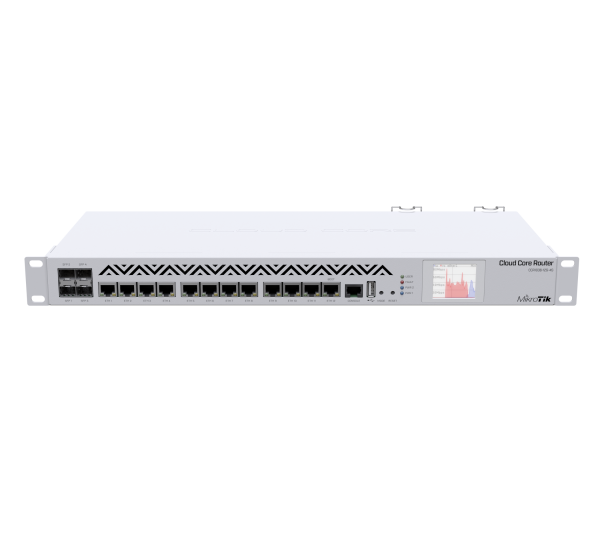
The CCR1036 is a 1U rack-mounted router designed for demanding network environments. Its primary strength lies in its Tilera TILE-Gx36 system-on-a-chip, which features 36 CPU cores running at 1.2 GHz, dedicated to packet processing. This makes it exceptionally good at tasks like firewall filtering, QoS, and VPN, especially when those features are enabled.
Key Specifications at a Glance
Detailed Analysis of Features
1. The "Cloud Core" CPU (Tilera TILE-Gx36)
This is the most defining characteristic.
36 Cores: The routing and firewall processes are distributed across all 36 cores. This means that even with complex rule sets, performance remains high because the load is balanced.
Purpose-Built: This architecture is designed for high-throughput packet processing, not for general-purpose computing. It excels at the tasks a router needs to do.
Comparison to Modern CCRs: Newer CCR models (like the 1072, 2004, etc.) use modern x86 CPUs or other multi-core architectures. The TILE architecture is older and has some limitations in single-threaded performance and support for certain newer features (like Container support in RouterOS 7).
2. Port Configuration
The "12G-4S" in the name breaks down as:
12 x Gigabit Ethernet Ports: These are all on a single, integrated switch chip. This means inter-VLAN routing between these ports happens at wire-speed (non-blocking). It's perfect for connecting multiple access switches, servers, or other gigabit devices.
4 x SFP+ Cages: These support both 1G SFP and 10G SFP+ modules. This is ideal for:
Uplinking to a core switch or another router.
Connecting to a high-speed storage server.
Aggregating multiple gigabit links.
3. Performance
This router was a performance champion in its day. Real-world performance depends heavily on the configuration:
Simple Routing: Can easily handle 10 Gbps+ of simple routing (no firewall rules, no queues).
Firewall/NAT: With a large number of firewall rules, it can still handle multiple gigabits per second.
VPN Performance: This is a key strength.
IPsec: Can achieve several Gbps.
FastTrack: Bypasses the firewall for established connections, allowing near-wire-speed performance for bulk traffic.
Strengths and Advantages
Raw Power for the Price (Used): On the secondary market, it offers incredible processing power for a fraction of its original cost.
Excellent VPN Gateway: Ideal for acting as a site-to-site or remote-access VPN concentrator.
High Port Density: 12 Gigabit ports and four 10G ports in a 1U form factor is very versatile.
Full RouterOS License (Level 6): No feature restrictions. You get access to every tool MikroTik offers.
Proven Reliability: These units are known for being workhorses and are very stable once configured correctly.
Weaknesses and Considerations
Aging Architecture: The Tilera CPU is older. Newer x86-based CCRs might be more efficient for certain tasks.
No Hardware Offloading for Certain Features: Unlike some newer models with switch chips that offload VLAN bridging, the CCR1036's switching is handled by its CPU (though it's very efficient at it). Complex traffic shaping (Queues) always uses the CPU.
Power Consumption: It's not as power-efficient as modern ARM or x86 alternatives. It can draw 50-70W, which adds up over time compared to a 15W RB5009.
RouterOS 7 Limitations: On RouterOS v7, it does not support the "Container" feature due to its non-standard CPU architecture.
Noisy Fans: The stock fans can be quite loud, making it unsuitable for a home office or quiet environment without modification.
-750x250.png "Datacom Technologies (BD)")
-70x60w.png "Fortinet FG-300E / FG-301E – Next-Generation Firewall Appliance")