Key Specifications & Features
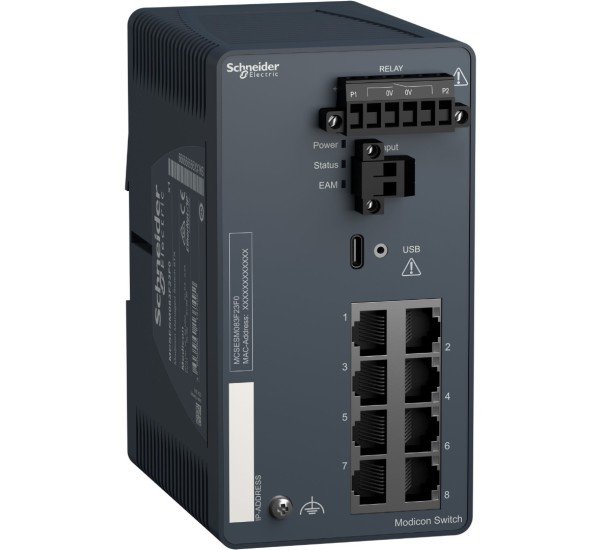
Port Configuration: 8 x 10/100/1000BASE-TX RJ45 ports.
Gigabit Ethernet: This is the most significant upgrade. All ports support 1 Gbps speeds, providing 10x the bandwidth of the previous models for data-intensive applications.
Auto-negotiation & Auto-MDI/MDIX on all ports.
Modern Network Topologies & Redundancy:
RSTP/MSTP: For standard loop prevention and redundancy.
Advanced Ring Protocols: It often supports proprietary ring protocols (like Schneider's "Tofino" technology or other G.8032 ERPS compatible rings) with ultra-fast recovery times (<10ms), making it ideal for real-time control networks.
No Fiber Ports: Being all-copper, it's designed for device connectivity and backbone use over copper cabling (Cat5e/6). For fiber connections, you would pair it with media converters or use switches that have SFP slots (a more flexible alternative to fixed fiber ports).
Enhanced Management & Smart Features:
Layer 2+ Features: Full L2 management (VLANs, QoS, IGMP Snooping v3, SNMP, Port Mirroring) plus advanced features like Link Aggregation (LACP) to combine multiple ports for higher throughput and redundancy.
Security: Advanced security suites including 802.1X, MAC-based port security, ACLs (Access Control Lists).
User-Friendly Management: Modern web interface (HTTPS), CLI via SSH (secure), and often integration with EcoStruxure Network Advisor for centralized management.
PoE Option Important: Check the exact suffix. There are variants of the 8-port model that support Power over Ethernet (PoE/PoE+). A model like MCSESM083F23F0 might be non-PoE, but a suffix change (e.g., ...P0) indicates PoE. PoE models can power devices like IP cameras, wireless access points, or compact HMIs directly, simplifying wiring.
Industrial Ruggedness:
Operating Temperature: Standard industrial range (e.g., -40°C to +70°C).
Power Supply: 24V DC or 110/230V AC variants are common. Redundant power inputs are typical.
Certifications: UL, cUL, CE, possibly ATEX/IECEx Zone 2. It meets industrial EMI, shock, and vibration standards.
Typical Use Cases
This switch is designed for bandwidth-hungry and modern industrial applications:
High-Speed Machine Networks: Connecting multiple servo drives, vision systems, and high-resolution HMIs that generate large amounts of data.
Industrial IT/OT Convergence: As a backbone switch in a control cabinet, connecting to servers, historians, and other IT infrastructure requiring Gigabit speeds.
Building Resilient Copper Rings: Forming high-speed, redundant network backbones using standard Ethernet cabling within a factory floor or plant area.
Aggregation Switch: Acting as a local aggregator for multiple smaller switches or a dense cluster of devices.
PoE Applications (if equipped): Deploying and powering a network of IP devices like security cameras, phones, or sensors from a single switch.
Comparison with Previous Models
Potential Considerations
No Built-in Fiber: For long-distance or noisy connections, you'll need separate media converters or switches with SFP slots for flexibility.
Power Consumption: Gigabit ports, especially PoE+ models, consume more power. Ensure your power supply is adequate.
Heat: Higher performance may require more attention to cabinet cooling, especially in high ambient temperatures.
Cost per Port: Generally offers a lower cost per managed Gigabit port compared to the more specialized fiber-centric models.
The Schneider Electric ConneXium MCSESM083F23F0 is a high-performance, versatile, all-Gigabit managed switch for modern industrial networks. It is the go-to choice when you need bandwidth, high port density, and advanced management features on a copper-based network.
Choose this model if you need:
Future-proof Gigabit speeds for data-heavy applications.
To connect a larger number of devices in a single location.
To build a high-speed, redundant copper backbone.
The convenience of Power over Ethernet (if selecting the PoE variant).
A modern managed switch for general industrial automation outside the specific need for fixed fiber ports or ultra-specialized substation protocols (HSR/PRP).
-750x250.png "Datacom Technologies (BD)")


-70x60h.jpg "Schneider Electric ConneXium MCSESM063F2CS0 – 6-Port Managed Switch (4×RJ45 + 2×SC)")