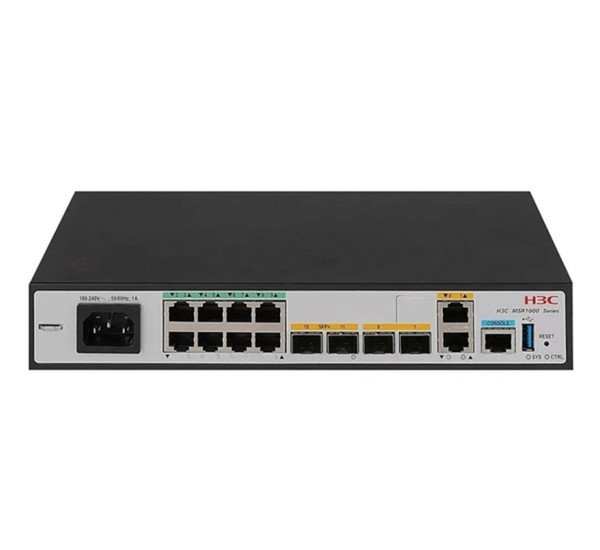
The MSR1008 is a 1U rack-mounted, modular router that strikes a balance between fixed configuration simplicity and expansion flexibility. It's built to handle multiple services simultaneously, such as routing, security, voice, and wireless, making it a true "all-in-one" device for branch offices.
Key Specifications at a Glance
Detailed Analysis of Features
1. Fixed Port Configuration
The "1008" in the name primarily refers to its eight built-in Gigabit Ethernet ports.
Flexible Role Assignment: These ports are not hard-coded as WAN or LAN. They can be configured in any combination, e.g., 2 WAN ports for dual internet connections and 6 LAN ports for internal devices.
Switching Capability: The ports can be grouped into a single broadcast domain (a switch) or kept separate.
2. Modular Expansion (SIC Slots)
This is a key feature that differentiates it from simpler routers. The two SIC slots allow you to add functionality such as:
xDSL Modems: For connecting to DSL internet services.
E1/T1 Interfaces: For legacy digital line connections.
Serial Ports (Async/Sync): For old-school leased lines or console access to other devices.
SFP Fiber Slots: To add fiber uplinks (Gigabit SFP, not 10G SFP+).
4G/LTE Modems: For cellular backup or primary WAN connectivity.
3. Software & Feature Set
The MSR series runs H3C's Comware OS (v5 or v7, depending on the hardware generation), which is a robust, enterprise-grade operating system.
Routing: Supports static routes, RIPv2, OSPF, BGP.
Security: Stateful firewall, IPSec & SSL VPN, ACLs.
Unified Threat Management (UTM): Optional license for Application Control, IPS, Web Filtering, and Anti-Virus.
Voice Services: Can act as a VoIP gateway with the appropriate modules.
WAN Optimization: Basic features like data compression and TCP optimization.
Strengths and Advantages
Excellent Port Density: 8 built-in Gigabit ports is very handy for a branch office, reducing the immediate need for an external switch.
Expansion Flexibility: The SIC slots allow the router to adapt to various WAN technologies (DSL, Fiber, Cellular, Serial).
Enterprise Features: Runs the same Comware OS as larger H3C routers, ensuring feature parity and consistent management.
All-in-One Capability: Can consolidate routing, security, and WAN connectivity into one device.
Reliability: Designed for business-critical environments with high uptime requirements.
Weaknesses and Limitations
Performance with UTM: Like all UTM devices, enabling deep packet inspection (IPS, Anti-Virus) will significantly reduce throughput.
Subscription Costs: Advanced UTM features require ongoing subscription fees for signature updates.
Older Hardware: Depending on the specific version, the MSR1008 may use older-generation processors that can't compete with the raw throughput of modern MikroTik CCRs.
Complexity: Comware OS, while powerful, has a steeper learning curve than a typical consumer router.
Ideal Use Cases
Enterprise Branch Office: The classic use case. Provides secure, reliable connectivity back to headquarters via VPN, with flexibility for various local WAN connections.
Small Business Main Gateway: For a business with 20-100 users that needs multiple internet connections (e.g., fiber primary, 4G backup) and integrated security.
Retail Chain Store: Connects all POS systems and provides guest WiFi, often with cellular failover installed via a SIC module.
Voice-Enabled Site: Can be equipped with voice interface cards to connect to traditional PBX systems or provide VoIP services.
-750x250.png "Datacom Technologies (BD)")