Key Features
Gigabit Ethernet Performance:
Modular Design (Key Feature):
Unlike the fixed-port X-200 series, many X-300 models feature a modular design. They have a fixed number of ports on the base device and expansion slots for adding optional media modules.
This allows you to customize the switch with the exact combination of ports you need:
Electrical RJ45 (10/100/1000 Mbps)
Multi-mode Fiber (SC, LC)
Single-mode Fiber (SC, LC) for long-distance connections
Plastic Optical Fiber (POF)
SFP Slots (Mini-GBIC): For the ultimate flexibility using hot-pluggable SFP transceivers.
Advanced Managed Functions:
All features of the X-200 series (VLAN, QoS, RSTP, IGMP Snooping) are present and enhanced.
Advanced Security: Includes more robust security features like 802.1X (Port-Based Network Access Control), RADIUS client support, and extensive ACLs (Access Control Lists).
Advanced Diagnostics: Features like LLDP (Link Layer Discovery Protocol) for automatic network topology discovery and detailed port statistics.
IT Functions: Supports features like DHCP Option 82, which are important for integrating industrial networks into larger corporate IT infrastructures.
Comprehensive Redundancy:
MRP (Media Redundancy Protocol): Fully supports the PROFINET standard for media redundancy (< 200ms recovery).
MRPD (MRP for Dynamically): Supports the redundancy mechanism for PROFINET IRT networks.
HSR (High-Speed Redundancy) & DRP (Dual Ring Protocol): Continues support for Siemens' proprietary fast-redundancy protocols.
Standby Function: For power supply redundancy.
Robust Industrial Design:
Built with a metal housing for DIN rail mounting.
Wide operating temperature range (-40 °C to +70 °C).
High EMC immunity and protection class (typically IP30).
Common Models and Variants
The X-300 family is diverse, but can be broken down into a few key categories:
SCALANCE X-300 (Standard Modular Switches):
X-306-1LD: A core backbone switch. It has 6 fixed 10/100/1000 Mbps RJ45 ports and 1 expansion slot for a media module (e.g., 2x Gigabit SFP).
X-308-2: A high-port-count modular switch. It has 8 fixed 10/100/1000 Mbps RJ45 ports and 2 expansion slots.
SCALANCE X-300 (Fixed Port Switches):
SCALANCE X-300 PoE Series:
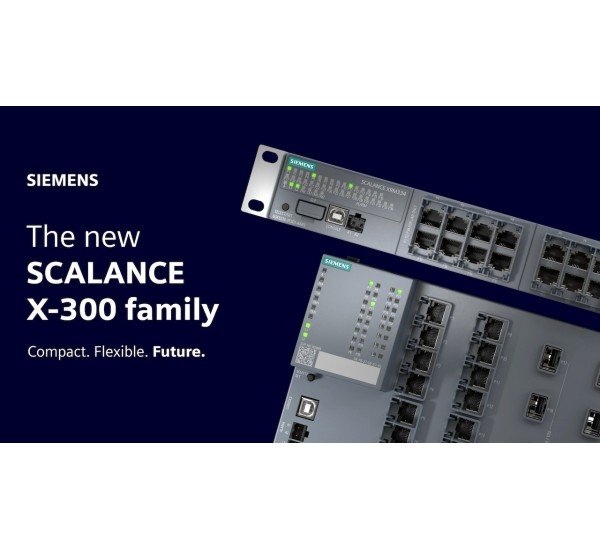
SCALANCE XR-300 Series (Rack-Mount):
Typical Applications
The X-300 series is deployed in demanding network roles:
Factory Backbone Switch: Acting as the central switch in a production line or cell, connecting multiple X-200 series switches and handling the aggregate traffic.
Network Consolidation Point: In a control room, using an XR-300 rack-mount switch to aggregate connections from the entire factory floor.
Process Plant Networks: Where long-distance fiber optic connections (via Single-Mode SFPs) are needed between distant areas of a large plant.
High-Availability Systems: In ring or mesh topologies using MRP or HSR for critical applications where any network downtime is unacceptable.
Configuration with TIA Portal
Like the X-200 series, the X-300 is deeply integrated into the Siemens ecosystem:
Its GSDML file is imported into the TIA Portal hardware catalog.
It can be dragged into the network view, configured (IP, rings, VLANs), and diagnosed alongside PLCs and drives.
Its advanced diagnostics provide detailed information that can be read by the PLC for predictive maintenance.
Summary: Pros and Cons
The Siemens SCALANCE X-300 series is a powerful and flexible family of industrial switches that form the reliable backbone of many industrial networks. It successfully bridges the gap between the basic connectivity of the X-200 series and the ultra-high-end features of the X-400 series.
Its direct successor in the modern portfolio is the SCALANCE XM-400 series, which offers even greater performance (10 Gigabit uplinks), enhanced security (NAT, firewall options), and a more modern form factor. However, the X-300 remains an extremely popular, proven, and widely deployed solution.
-750x250.png "Datacom Technologies (BD)")